

Home / Technology
A carrier, an adjuvant, and a delivery vehicle in one molecule
CTA2/B is a non-toxic derivative of cholera toxin engineered to carry Staphylococcus aureus antigens directly to the immune cells that guard mucosal and skin surfaces.
Why cholera toxin
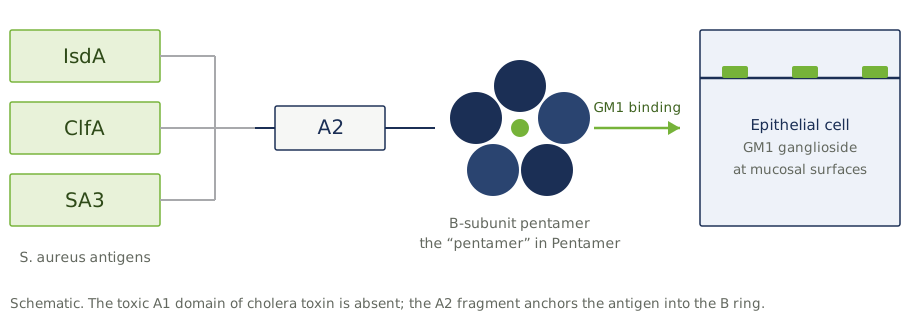
Cholera toxin is one of the most potent mucosal adjuvants known, and the reason is structural. Its B subunit is a pentamer — five identical chains forming a ring that binds GM1 ganglioside on host cells and triggers uptake into the cell. Its A subunit carries the toxicity: the A1 domain enters the cytosol and disrupts cell signaling.
CTA2/B keeps the delivery machinery and discards the toxin. The A2 fragment anchors a fused antigen into the B pentamer; the enzymatically active A1 domain is gone. The result retains adjuvanticity without the toxic activity.
The B ring — the pentamer the company is named after — is what delivers the vaccine to the immune cells at the nasal, gut, and skin surfaces where S. aureus colonizes before it infects.
The construct is the same whether the target is a cow or a person. Only the fused antigens change: IsdA and ClfA for the bivalent candidates, the three-antigen SA3 payload for the trivalent construct.
Why IsdA and ClfA
IsdA — iron-regulated surface determinant A — and ClfA — clumping factor A — are S. aureus surface adhesins involved in iron uptake. They are what the organism uses to attach to host tissue, which makes them what an antibody response should block.
Two constructs, one carrier
Bivalent
IsdA-CTA2/B and ClfA-CTA2/B, co-administered. This is the construct evaluated in the bovine intramammary study and in preclinical immunogenicity work.
Trivalent SA3
SA3-CTA2/B, a single construct carrying three antigens, being scaled to broaden coverage across diverse human isolates including MRSA.
Recombinant, scalable, no live organism
E. coli expression system.
Protein expression and folding in culture.
Glycan affinity chromatography.
Protein analysis and concentration.
Recombinant subunit production: no live organism, no attenuation to validate — a simpler path to GMP manufacturing.
The carrier is the delivery system
A vaccine that requires a trained injector, a sharps protocol, and a cold chain is a vaccine that does not reach everyone who needs it. The platform does not need a needle because the molecule itself does the delivering: the B-pentamer binds GM1 on epithelial cells and carries the fused antigen across the barrier surfaces. The lead route is intranasal.
Intranasal — lead route
A spray that establishes immunity at the nasal surface, where S. aureus colonizes before it infects.
Microneedle patch — related technology
A dissolvable patch under evaluation for transcutaneous dosing — no trained injector, no sharps, no cold chain.
In preparationPatch delivery has been demonstrated ex vivo in pig ear skin, with the chimera co-localising in the dermal layer. Manuscript in preparation.
Five issued U.S. patents
The CTA2/B platform is protected by five issued U.S. patents covering both preventative and therapeutic applications, the antigen fusions, and the delivery routes.
CTA2/B technology is licensed from Boise State University.